
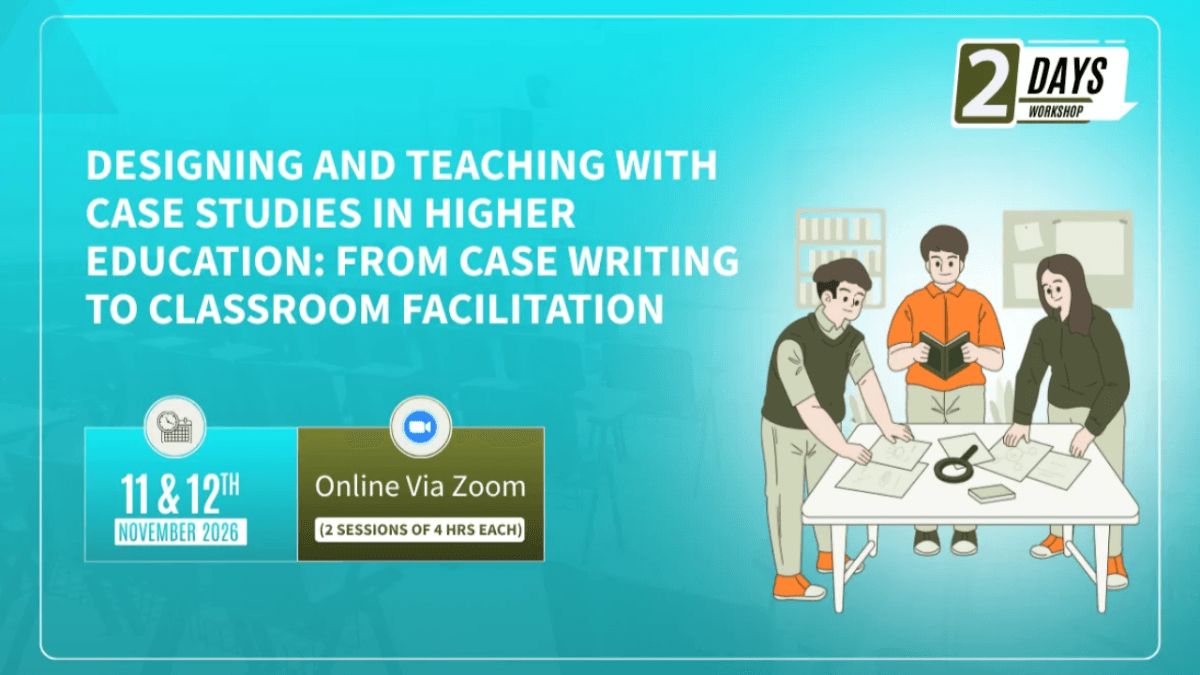
Designing and Teaching with Case Studies in Higher Education
Nov 11, 2026 - Nov 12, 2026
Date
7:00 AM - 11:00 AM
Time
Zoom
Location
£39 - £46
Cost
About This Event
Case studies have become a powerful pedagogical approach for bridging theory and practice, fostering critical thinking, enhancing learner engagement, and preparing students for the complexities of professional practice. However, effective case-based education requires not only the ability to write high-quality teaching cases, but also the pedagogical expertise to facilitate meaningful case discussions and design impactful learning experiences around them.
This two-part online workshop—jointly delivered by CLICKS and Emerald Publishing—provides higher education faculty with a comprehensive and practical introduction to both writing teaching case studies and teaching effectively with cases.
Drawing on internationally recognized editorial and pedagogical standards, the workshop guides participants through the full case-based learning cycle: from identifying and developing compelling teaching cases to facilitating inclusive discussions, aligning cases with learning outcomes, and assessing student learning.
Across two interactive 4-hour sessions, participants will explore how case-based learning can strengthen employability, active learning, critical thinking, authentic learning, problem-solving, decision-making, and reflective practice across disciplines and delivery modes.
The workshop will include short practical exercises, peer discussion, critique activities, and guided application tasks to support participants in developing and applying case-based teaching and writing skills.
Related Events

Creating happy classrooms for English learning
This session focuses on teacher and learner well-being, drawing on classroom practice to explore how joy, emotional safety and positivity can enhance English learning. The presentation shares practical ways teachers can create happier, more connected classrooms. About the speakers Mai Tuyet Ngo is an associate professor in TESOL and applied linguistics at Flinders University, Australia. She has been working as an English language teacher educator for 30 years, and has coached and mentored many young early-career Vietnamese schoolteachers, university lecturers and leaders to become healthier and happier. Her research interests are teachers' social well-being and happiness pedagogies. Donna Lim is a lecturer with the National Institute of Education, Nanyang Technological University, Singapore. She specialises in primary English language teaching methodology courses. Her area of interest is in developing literacy with a focus on teaching writing. She has considerable teaching experience with young learners. Yustinus Calvin Gai Mali is an associate professor in the Masters of English language education at Satya Wacana Christian University (Salatiga, Indonesia). He holds a PhD in Language, Literacy and Technology Education. He also serves as the director of publications at Indonesia Technology Enhanced Language Learning ( iTELL ) journal.

How can assessment be inclusive?
Speaker Nashwa Aly Muhammad Session information This practical session addresses the limitations of one-size-fits-all assessments. It explores the positive impact of creating equitable opportunities for all learners, including those with special educational needs, while catering to cultural differences and varied learning preferences. Learn about the key principles of accessible and inclusive assessment and how to integrate these to accommodate diverse needs, by providing alternative testing formats and designing fair and unbiased assessments.
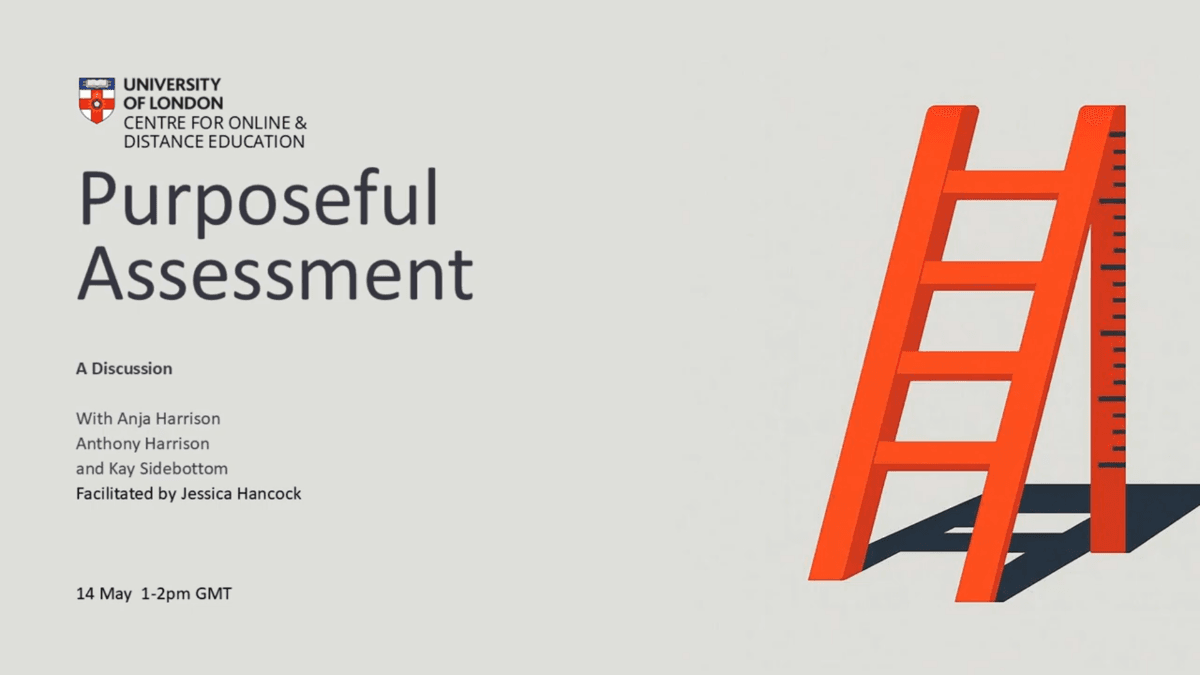
Purposeful assessment
In the sixth session of the free CODE learning and teaching webinar series , we will explore how we can design assessments that have purpose: to both measure whether students have met their learning outcomes, and also act as a learning opportunity in themselves. We will consider how the purpose of assessment can be to encourage not only learning, but also creativity and criticality, and what this might look like across different disciplines or institutions. How can we do this in the context of GenAI where students might be less motivated to focus on their own thoughts or responses in fear of getting it wrong, or in a situation when they feel too time-poor to successfully complete assessment? This session will explore some answers and approaches to this wicked problem. Purposeful assessment also needs to enable compassion and inclusivity, to ensure that all students feel able to get the most out of assessment opportunity - so these considerations will also be foregrounded during the session.

Culture, confidence and communication in the EFL classroom
Understanding your context In the first event in our series of webinars on practical approaches for your teaching context, two of our course tutors introduce strategies for making your teaching relevant to your learners, your classroom and your wider context. The second session focuses on designing projects that celebrate local culture and cultural exchange while building communication, teamwork and creativity. These activities strengthen learner confidence and place an understanding of culture and context at the heart of your classroom. The live event took place on 17 April 2026. This workshop gives you practical ideas to help you celebrate culture in your classroom through collaborative projects. You learn how to design a clear project framework for learners to present cultural content, which will help them develop communication skills, collaboration and creativity. Including cultural content in your classes can encourage empathy and intercultural understanding as well as boosting learner confidence. Watch the session to find out more!
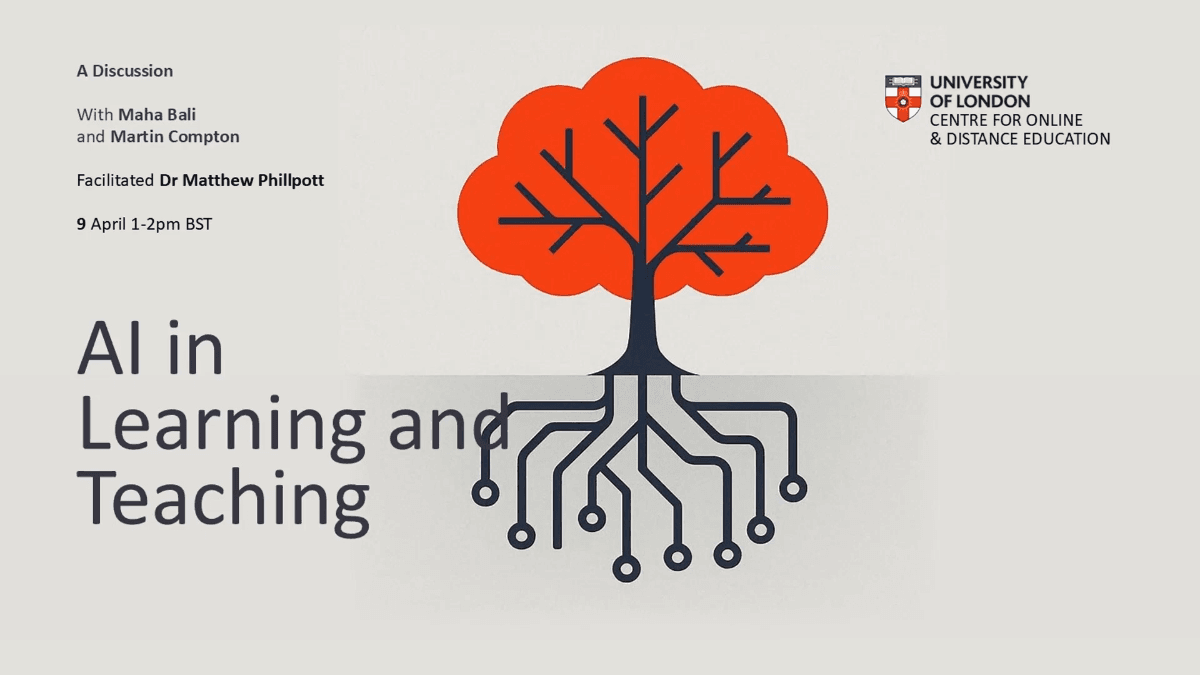
AI in learning & teaching
Explore the transformative impact of AI tools on higher education, with discussions on practical applications, ethical concerns, and the evolving role of educators in an AI-enabled world. In the fifth session of the free CODE learning and teaching webinar series , we will explore the positive and challenging impact on learning and teaching in Higher Education by Gen AI tools. In particular, we will discuss practical applications of using AI-powered systems in the curriculum and how these can enhance learning and teaching while also considering the concerns, issues around equity and privacy, and how the role of the educator needs to evolve to prepare students for an AI-enabled world. The session will draw from recent UK case studies and international best practices.

Including learners' languages in English teaching
This session brings together two teacher educators to discuss how multilingual realities shape English teaching in Southeast Asia. Speakers explore how teachers use learners' home languages as a resource, challenge 'English-only' assumptions and promote inclusive, culturally responsive practices. Donna Lim focuses on young learners and Yustinus Calvin Gai Mali talks about pre-service teachers. Learn about strategies that you can use in your classroom, wherever you teach. About the speakers Mai Tuyet Ngo is an associate professor in TESOL and applied linguistics at Flinders University, Australia. She has been working as an English language teacher educator for 30 years, and has coached and mentored many young early-career Vietnamese schoolteachers, university lecturers and leaders to become healthier and happier. Her research interests are teachers' social well-being and happiness pedagogies. Donna Lim is a lecturer with the National Institute of Education, Nanyang Technological University, Singapore. She specialises in primary English language teaching methodology courses. Her area of interest is in developing literacy with a focus on teaching writing. She has considerable teaching experience with young learners. Yustinus Calvin Gai Mali is an associate professor in the Masters of English language education at Satya Wacana Christian University (Salatiga, Indonesia). He holds a PhD in Language, Literacy and Technology Education. He also serves as the director of publications at Indonesia Technology Enhanced Language Learning ( iTELL ) journal.

Making testing more creative and authentic
Speaker Paula Asad Session information Have you ever felt overwhelmed by stacks of test papers, questioning whether they truly reflect what your learners know or can do? In this practical webinar, we reimagine traditional testing and explore creative strategies to help learners authentically demonstrate their learning. Discover how to use whiteboards and exit tickets for instant feedback, how to apply teach-back methods to deepen understanding and how to design authentic assessments that foster higher-order thinking.
Do pupils understand AI tools better than we do?
How can we help students become thoughtful, critical users of AI? In this episode of Teachwire Talks, host Helen Mulley explores what pupils really understand about the AI tools they’re already encountering. Alongside Helen are guests Ben Garside and Emma Staves, both former educators now working at the Raspberry Pi Foundation . Together, they discuss what AI literacy means and how to teach it when you’re still getting to grips with AI yourself. About Experience AI Experience AI is an educational programme that offers cutting-edge resources on artificial intelligence and machine learning for teachers and students. Developed in collaboration by the Raspberry Pi Foundation and Google DeepMind, the programme supports teachers in the exciting and fast-moving area of AI, and gets young people passionate about the subject. Experience AI lessons The set of free lessons has everything teachers need to deliver AI and machine learning sessions in secondary school, including lesson plans, slide decks, worksheets, and videos. The lessons focus on AI applications that are relatable for young people and are designed so that teachers in a wide range of subjects can use them.
Anti-Racist Shakespeare Webinars: Hamlet
In this webinar, Globe Co-Director of Education (Higher Education and Research) Professor Farah Karim-Cooper is joined by Professor Ian Smith and practitioner Naeem Hayat to discuss humanity, philosophy, and white masculinity in Hamlet.
Anti-Racist Shakespeare Webinars: A Midsummer Night's Dream
In this webinar, Globe Co-Director of Education (Higher Education and Research), Professor Farah Karim-Cooper is joined by performer Aldo Billingslea and scholar Dr Vanessa I. Corredera to discuss language, performance history and culture in A Midsummer Night’s Dream.

3 Ways to Pause Before Acting | A Conversation with Andrew Miller
What you'll hear in this episode. Dr Andrew Miller, Academic Principal at Beijing International Bilingual Academy, explains what going slow really looks like for a school leader and why "maybe don't" could be the most useful phrase you say all year. His career spans Washington State's Office of Superintendent of Public Instruction, Singapore American School and Shanghai American School, so he has seen how pressure to move fast plays out in very different systems. There is also a story behind this episode: Shane's audio failed to record, so you hear Andrew's answers as they were given on the day, with short bridge lines from Shane to set up each question. You'll learn how to tell deliberate slowness apart from avoidance or a loss of nerve, and how Andrew resets his own sense of urgency on the days when he feels he hasn't done enough. He also covers how to let staff see your thinking without it sounding like excuses, and where the line sits between useful vulnerability and venting. Shane closes with three practical steps to try this week, starting with writing down what would happen if you didn't launch that next initiative. If everyone around you is waiting for you to act, this conversation gives you a way to pause with confidence.

Understanding your context: A practical introduction
Understanding your context In the first event in our series of webinars on practical approaches for your teaching context, two of our course tutors introduce strategies for making your teaching relevant to your learners, your classroom and your wider context. The second session focuses on designing projects that celebrate local culture and cultural exchange while building communication, teamwork and creativity. These activities strengthen learner confidence and place an understanding of culture and context at the heart of your classroom. The live event took place on 17 April 2026. In this practical introduction to the professional practice Understanding your context, our course tutors will explore how you can adapt materials and resources to suit your learners' needs, interests and backgrounds. They will share resources and strategies for teaching large, mixed-level classes. You will find out how your learners' home languages and cultures can become valuable resources in the classroom.