

Most Able Pupils Conference 2027
Wednesday, January 20, 2027
Date
9:30 AM - 4:30 PM
Time
Online
Location
£395 - £520
Cost
About This Event
Recent research suggests that high-attaining pupils are not always sufficiently challenged, while longstanding questions remain about the classroom practices that most effectively support high attainment within inclusive learning environments. Schools also face growing challenges in sustaining high attainment, sufficiently challenging high-attaining pupils, and addressing increasing disengagement during key educational transitions.
At the same time, attainment gaps have widened since the pandemic, with disadvantaged pupils estimated to be more than 19 months behind peers by age 16 (Education Policy Institute, 2024). These trends underline the crucial need for evidence-informed approaches that identify, challenge, and support most able learners throughout their educational journey.
With the Every Child Achieving and Thriving White Paper (Feb 2026) highlighting the importance of stronger partnerships between schools, families and government, there is an urgent need to move from ambition to implementation. By prioritising effective implementation strategies, targeted support and meaningful collaboration, education providers can ensure high-attaining pupils from all backgrounds are identified, challenged and supported, enabling every learner to thrive.
The Most Able Pupils Conference 2027 provides a platform for educators, leaders and practitioners to share and develop pedagogical approaches that improve outcomes for most able learners. It prioritises actionable teaching and learning strategies led by institutions holding the NACE Challenge Award and NACE Challenge Ambassador title, whilst simultaneously exploring how curriculum design, teaching to the top, oracy, metacognition, engagement and emerging technologies can be applied to stretch thinking and raise attainment for the most able pupils across all phases of education.
Organiser
Government Events
info@governmentevents.co.ukGet notified by email when they post new events.
Share This Event
Related Events

Data informed decision making - Your Choice webinar recording
Get the highest quality CPD from experts at your convenience, with nasen's SEND CPD on Demand - The ultimate flexible training resource. This webinar explores how effective data collection and analysis can improve decision making, and have positive impact on SEND provision across settings . • The importance of sound, evidence and data informed decision making • The decisions we make – provision management • What data sets do we use • How do we analyse data and why • The difference evidence based practice makes Full access to this resource is available for £10.

Episode 4 - Defunded Not Derailed: Alternatives for Level 3 Computing, IT and Cyber Security Quals
Episode Date: Thursday 2nd April 2026 Computing, IT and cyber security is one of the fastest-moving areas in post-16 education, and one of the most directly affected by qualification reform. As large applied qualifications are phased out, colleges delivering digital programmes must rethink how they structure provision to meet both learner needs and an industry that evolves by the month. In Episode Four of Defunded, Not Derailed, we move from science to digital, applying the same subject-specific lens to explore what strong Level 3 computing, IT and cyber security provision looks like from here. What qualification alternatives are available? How can colleges design programmes that keep pace with rapid industry change? And what role might V Levels and mixed study programmes play in shaping digital pathways? Gavin O'Meara is joined by Vinay Thawait, Subject Advisor at Cambridge OCR, Aman Purewal from Coventry College, and Kris Hyde from Callywith College, to explore how digital specialists are navigating reform and what curriculum leaders should be considering now. Defunded Not Derailed was produced by FE News in partnership with Cambridge OCR.

Inclusion 2.0: a fireside conversation with Daniel Sobel
What’s next for inclusion - and what will it really take to move from good intentions to embedded practice? Thrive is proud to be forging a new strategic partnership with the International Forums of Inclusion Practitioners (IFIP) - a global community committed to strengthening inclusive practice for every teacher and every learner. To mark the partnership, join Viv Trask-Hall, recently recognised as a Distinguished Fellow of IFIP, for a relaxed fireside conversation with Daniel Sobel - Chair of IFIP, President of the World Inclusion Congress (WIC), and Chief Exec of Inclusion Expert. Together, Viv and Daniel will explore what this partnership means in practice, what’s shifting globally in inclusion right now, and Daniel’s vision for Inclusion 2.0 - the next phase of inclusion that moves beyond policy into culture, leadership and everyday practice. We’ll also dive into questions including: What’s the biggest misconception schools hold about inclusion today? What does inclusion look like when it’s truly embedded — not just talked about? What patterns are emerging internationally, and what can we learn from them? Expect a candid, practical discussion, with space for audience questions and real-world reflections for leaders, practitioners and educators.

How to create a sense of belonging in the early years
Every child needs to feel that they belong – to know they are safe, seen and significant. Explore how to create a genuine sense of belonging in early years settings and why this is crucial for mental wellbeing and healthy brain development. Watch the webinar to learn: Why a strong sense of belonging is so important for young children's development and what it looks like in early years settings How to create inclusive, predictable spaces where children feel secure enough to express themselves and explore Practical ways to listen to children’s voices and involve them in shaping their environment and routines
Let me hear the real you!
In this webinar, David Byrne and Mark Heffernan will explore the importance of discussing voice and persona with learners. With the development of AI, it’s become even more important for learners to know their voice, to know how they want to come across, and to stand out from AI generated content. This content is available to Modern English Teacher subscribers.

The Schools White Paper & Inclusion at Scale
The Schools White Paper Every Child Achieving and Thriving raises expectations for inclusion - earlier, more consistently, and across every school, backed by £1.8bn in new investment. But for many trusts, the challenge isn’t understanding what’s expected. It’s making it work in practice, at scale. Practice varies between schools. Capacity is stretched. Needs are more complex. What works in one school doesn’t always translate across others. Research from Thrive and ImpactEd, based on over 1,000 education professionals, highlights a clear “inclusion readiness gap” - between expectations and the conditions needed to deliver them. At the same time, £1.8bn in new investment creates a significant opportunity - but only if it’s used to strengthen delivery across the trust. In this session, Tom Preston, Viv Trask-Hall and Liz Murray will share what they’re seeing across the system and what seems to be making a difference. You’ll learn: What the White Paper means in practice for trust-wide inclusion Where delivery tends to break down across schools Why some approaches don’t scale - and what to do instead How to use new investment to build capacity across your trust How to assess and strengthen inclusion readiness
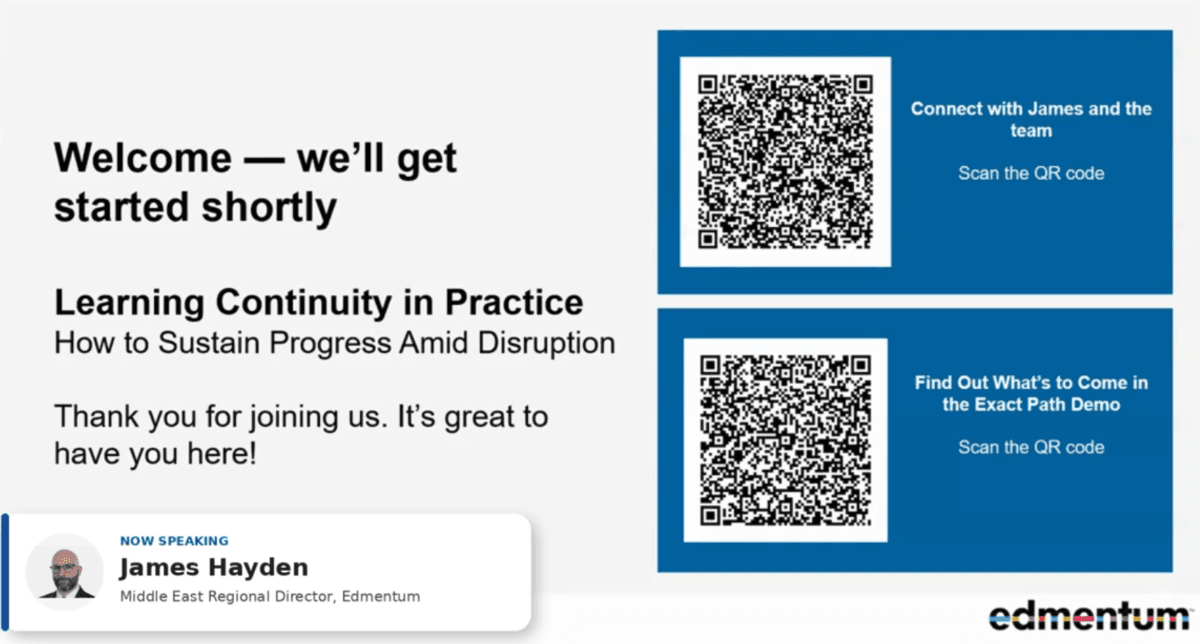
Learning Continuity in Practice: How to Sustain Progress Amid Disruption
This webinar explores how schools can adapt quickly, support students at different starting points, and maintain meaningful progress through disruption. Join Lee Dabagia , Principal at Summit International School , Dr. Tim Hughes , Director of Academic Quality Assurance & School Improvement at Bloom Education , Gemma Thornley , Principal at The Arbor School , and other leading practitioners, for a practical discussion on supporting learning continuity, helping students catch up, accelerating progress, and preparing students for a confident transition into the next academic year. In this session, you'll gain insights to: Identify unfinished learning and priority skill gaps Use structured and independent learning to accelerate progress Support students at different starting points across flexible learning models Strengthen visibility of progress for teachers, leaders and families Maintain learning continuity without increasing teacher workload Prepare students for a confident academic transition

AI and wellbeing: what schools are noticing and why it matters
What is the webinar about? Children and young people are growing up alongside AI tools that respond instantly, adapt to them, and feel surprisingly conversational. These moments can spark curiosity and connection, but they also introduce pressures that may shape how young people feel, relate and regulate - and the pace of change is faster than our understanding of its emotional impact. Join us for a fireside conversation where Thrive’s Viv Trask-Hall is joined by digital education specialist, Anthony Magee, and Safeguarding and Mental Health GLF Trust Lead, Fiona Jarman, to explore the emerging ways AI is shaping children’s emotional and social worlds, and how schools can respond. You’ll gain a high-level understanding of the emerging impact of AI, drawing on data and behavioural insights, alongside relational perspectives on supporting young people’s wellbeing as technology evolves.
If technology is so clever, why are teachers so busy?
Are today’s classroom technologies really making teachers’ lives easier? In this episode of Teachwire Talks, Helen Mulley is joined by Ashleigh Kennedy from Dell Technologies and product marketing consultant Richi Fontaine to explore whether edtech is living up to its promise. Together, they discuss how technology has transformed schools, from interactive whiteboards to AI, and examine why workload remains such a challenge, even as new tools continue to emerge. Finally, they share practical insights into using digital tools more strategically, helping you save time while improving teaching and learning. About ED360 Teachers are under growing pressure to manage heavier workloads, respond to diverse student needs, close learning gaps, and confidently adopt new digital and AI-enabled approaches in the classroom. To support them effectively, schools need practical tools and accessible professional learning that can make an immediate difference. A clear next step is to register to join ED360 – Dell’s hub for smarter teaching – where educators can explore practical ideas, tackle common challenges, and see how modern technology and AI can support teaching and learning. The platform includes webinars, podcasts, classroom-ready resources, and expert-led content designed to help schools embrace future-ready IT and bring AI-driven learning into the classroom. Alongside ED360, educators can also benefit from other valuable resources such as Microsoft Learning Zone and Intel Skills for Innovation. Intel Skills for Innovation helps educators integrate technology into everyday learning through ready-to-use lesson plans, professional development, and real-world projects that build digital, problem-solving, and innovation skills. Microsoft Learning Zone is an AI-powered education app from Microsoft designed to help teachers create interactive lessons and learning activities more quickly. Register to join ED360 here . By encouraging teachers and school leaders to engage with ED360 and these wider resources, we can help reduce pressure, build confidence, and give educators practical support to create more engaging, inclusive, and future-ready learning experiences.
On-demand webinar: AI Black Box: responsible use for primary teachers
Webinar series: AI in Primary History Session 4: AI Black Box: responsible use for primary teachers Presenter: Dr Vanessa Cui, Dr Louise Wheatcroft, Dr Jordan Bird Generative AI offers incredible potential for resource creation for teachers, but the current dominant generative AI tools' core function is to be an agreeable, helpful assistant. This often leads to oversimplified narratives and a lack of necessary nuance and criticality, not to mention the common ethical challenges generative AI tools present such as bias, inaccuracy and environmental impact. These challenges potentially can compromise the quality of teaching materials and the ethics of teachers' practice. This focused 60-minute session is designed to inform teachers about principles of how dominant Generative AI models function, including the crucial role of Alignment (training on human preference) in the way generative AI responds to human inputs with the aim to empower teachers to confidently understand, evaluate, and responsibly use generative AI tools across their professional practice. This session includes: Understanding agreement: explain the principle of alignment (human preference training) to teachers and why it causes AI to avoid complexity, challenge, and conflicting evidence. The criticality challenge: evaluate the key pitfalls of using AI for history — including historical bias, presentism, and factual hallucinations — and learn to spot them. The CLEAR Prompting Framework: you will gain an actionable framework designed for more critical engagement with dominant generative AI tool and consider its use in your practice. Action plan for responsible use: leave with a concrete plan, identifying up to three actions you can responsibly integrate AI into your professional practice, including the necessary steps for safe and ethical implementation in your school. Non-member instant-access price: £45.00 HA Members can get instant access for £30.00

How can assessment be inclusive?
Speaker Nashwa Aly Muhammad Session information This practical session addresses the limitations of one-size-fits-all assessments. It explores the positive impact of creating equitable opportunities for all learners, including those with special educational needs, while catering to cultural differences and varied learning preferences. Learn about the key principles of accessible and inclusive assessment and how to integrate these to accommodate diverse needs, by providing alternative testing formats and designing fair and unbiased assessments.

5 proven strategies for educators to help pupils express their emotions
Learn five key relational strategies that adults can use to support children and young people when they are overwhelmed by their emotions. Watch the webinar to learn: Effective strategies to support pupils when emotions feel overwhelming. Suggested practical activities to help embed these approaches in your setting. Ways to create a safe, nurturing environment where pupils feel heard and understood.