

Bett UK 2027
Jan 20, 2027 - Jan 22, 2027
Date
9:00 AM - 5:00 PM
Time
ExCeL London, Royal Victoria Dock, 1 Western Gateway, London, E16 1XL
Location
Free
Cost
About This Event
The world’s biggest celebration of education.
Bett UK 2026 welcomed over 37,000 members of the global education community, including 14,000 education decision makers and 700+ exhibitors from across 130 countries. Join us in 2027 as we come together once again with one shared purpose: to drive better education globally.
Explore the best of EdTech in one place
Explore the highest quality EdTech, take part in world leading demos and collaborate with industry leaders during three days of EdTech excellence. Bett UK 2027 is a must-attend event with the power to make a genuine impact on the lives of teachers and learners.
Meet the buyers who shape the future of education
We're bringing your target audience all together in one place and providing you with an unparalleled opportunity to meet them. Join Bett to save time, maximise your return on investment and unlock new opportunities at Bett UK 2027.
Be part of the world’s leading EdTech event
Discover groundbreaking solutions, connect with 37,000+ education professionals, and hear from inspiring global speakers. Don’t miss your chance to shape the future of education. Register today.
Free for all educators.
Related Events

Teaching about Migration Course

This course covers an introduction to teaching about migration using a trauma-informed approach, including the tools, knowledge and resources you need to feel confident teaching about migration, even if you have young people with lived experience of migration in the room. Learning outcomes By completing this course, you will: Understand the experiences of people with refugee status or people seeking asylum, whilst defining key terminology. Understand the impact of trauma on learners and apply six trauma-informed principles to teaching about migration. Use our teacher resources to engage and support your students. Masterclasses are available for groups of five or more and can be delivered online or face-to-face, subject to facilitator availability. To book a group masterclass, email redcrosseducation@redcross.org.uk with your group size, preferred dates, location and delivery method.

Teaching First Aid Course
Learn how to teach first aid to young people using the British Red Cross's Everyday First Aid approach, and using free medically approved, educationally sound resources. Learning outcomes By completing this course, you will: Understand the Everyday First Aid approach and how to use it to effectively teach first aid to your young people. Understand how to navigate and utilise our resources and activities on the First Aid Champions website to effectively teach first aid skills to young people. Be able to use our teaching resources to engage with your young people on the topic of first aid. Be able to use our first aid skill videos, which use the Everyday First Aid approach, to enhance your confidence and knowledge in first aid. Masterclasses are available for groups of five or more and can be delivered online or face-to-face, subject to facilitator availability. To book a group masterclass, email redcrosseducation@redcross.org.uk with your group size, preferred dates, location and delivery method.

Teachwire Talks - Are you smarter than a Stone Age engineer?
Are your pupils smarter than a Stone Age engineer? Helen Mulley investigates in this episode of Teachwire Talks, alongside Jennifer Wexler from English Heritage and maths communicator Thomas K Briggs. Together, they unpack how Stonehenge was constructed and precisely aligned to the solstices, revealing extraordinary ancient engineering and maths. They also chat about how these prehistoric problems can spark powerful STEM learning in today’s classrooms. Find out how you can bring prehistory to life with a school visit to Stonehenge . About the guests Jennifer Wexler is the historian of prehistoric sites at English Heritage, and former project curator on the Grave Goods Project and World of Stonehenge Exhibition at the British Museum. Her research interests include archaeological and mortuary landscapes, digital heritage, forgotten histories, and the public presentation of archaeology. Thomas K Briggs is a learning and education consultant for museums, galleries, libraries and archives, in the heritage sector and beyond. He is the author of The Mathematician’s Library , about the books that unlocked the power of number, and has also set up the History and Mathematics in Education Network (HaMiEN) to encourage and facilitate connections between people interested in history and maths.

Teaching Climate Preparedness Course
Welcome to Teaching Climate Preparedness, a comprehensive course designed to empower you with the confidence and skills to effectively teach climate preparedness using a holistic framework, developed by the British Red Cross. This course equips you with the resources, skills and training needed to successfully implement the holistic framework when teaching climate preparedness with your young people. Learning outcomes By completing this course, you will: Demonstrated an understanding of a holistic approach to climate education and why this is appropriate given the topic. Have gained an understanding of what extreme weather and eco-anxiety are, how they affect young people, and how to support emotional wellbeing through climate education. Identified key benefits of using the Weather Together toolkit to teach climate preparedness. Gained practical skills to use the Weather Together toolkit with young people. Masterclasses are available for groups of five or more and can be delivered online or face-to-face, subject to facilitator availability. To book a group masterclass, email redcrosseducation@redcross.org.uk with your group size, preferred dates, location and delivery method.
Let me hear the real you!
In this webinar, David Byrne and Mark Heffernan will explore the importance of discussing voice and persona with learners. With the development of AI, it’s become even more important for learners to know their voice, to know how they want to come across, and to stand out from AI generated content. This content is available to Modern English Teacher subscribers.
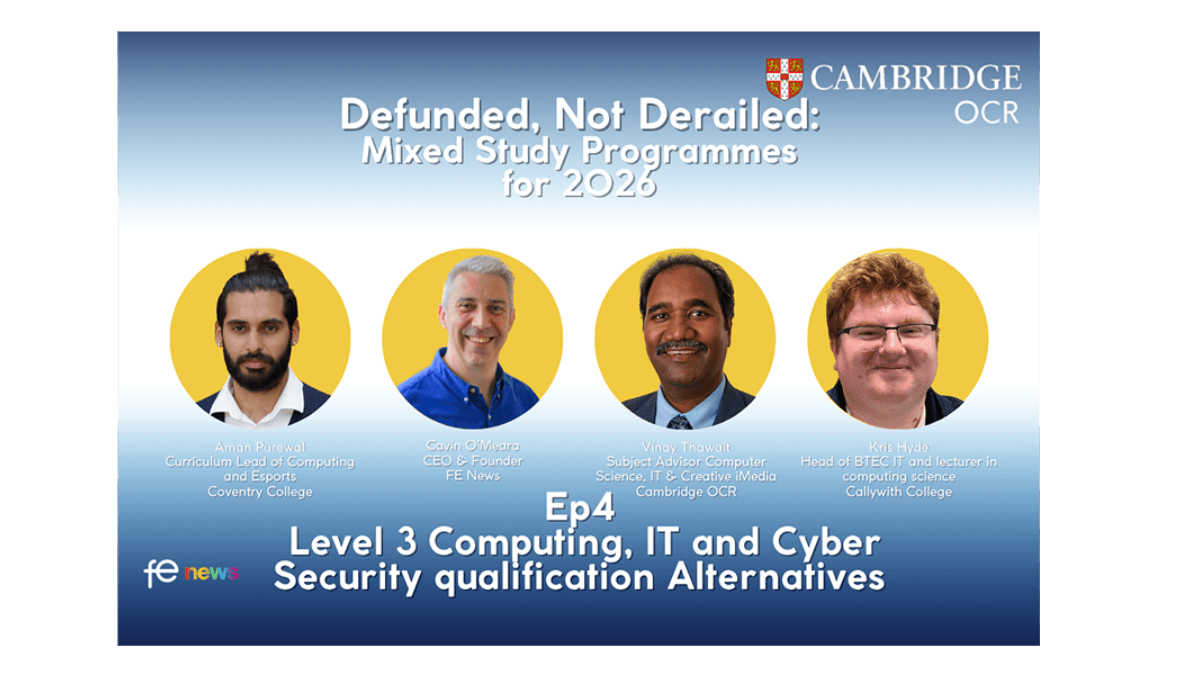
Episode 4 - Defunded Not Derailed: Alternatives for Level 3 Computing, IT and Cyber Security Quals
Episode Date: Thursday 2nd April 2026 Computing, IT and cyber security is one of the fastest-moving areas in post-16 education, and one of the most directly affected by qualification reform. As large applied qualifications are phased out, colleges delivering digital programmes must rethink how they structure provision to meet both learner needs and an industry that evolves by the month. In Episode Four of Defunded, Not Derailed, we move from science to digital, applying the same subject-specific lens to explore what strong Level 3 computing, IT and cyber security provision looks like from here. What qualification alternatives are available? How can colleges design programmes that keep pace with rapid industry change? And what role might V Levels and mixed study programmes play in shaping digital pathways? Gavin O'Meara is joined by Vinay Thawait, Subject Advisor at Cambridge OCR, Aman Purewal from Coventry College, and Kris Hyde from Callywith College, to explore how digital specialists are navigating reform and what curriculum leaders should be considering now. Defunded Not Derailed was produced by FE News in partnership with Cambridge OCR.

Teaching about War and Conflict Course
This course covers an introduction to teaching about global conflicts through the rules of war. It also includes handling the challenging conversations that can arise from this topic. Learning outcomes By completing this course, you will: Demonstrate an understanding of the principle of neutrality and the rules of war. Apply a five-step method to confidently facilitate challenging classroom discussions. Use our teaching resources to engage and support your students. Masterclasses are available for groups of five or more and can be delivered online or face-to-face, subject to facilitator availability. To book a group masterclass, email redcrosseducation@redcross.org.uk with your group size, preferred dates, location and delivery method.
Learning Continuity in Practice: How to Sustain Progress Amid Disruption
This webinar explores how schools can adapt quickly, support students at different starting points, and maintain meaningful progress through disruption. Join Lee Dabagia , Principal at Summit International School , Dr. Tim Hughes , Director of Academic Quality Assurance & School Improvement at Bloom Education , Gemma Thornley , Principal at The Arbor School , and other leading practitioners, for a practical discussion on supporting learning continuity, helping students catch up, accelerating progress, and preparing students for a confident transition into the next academic year. In this session, you'll gain insights to: Identify unfinished learning and priority skill gaps Use structured and independent learning to accelerate progress Support students at different starting points across flexible learning models Strengthen visibility of progress for teachers, leaders and families Maintain learning continuity without increasing teacher workload Prepare students for a confident academic transition
On-demand webinar: AI Black Box: responsible use for primary teachers
Webinar series: AI in Primary History Session 4: AI Black Box: responsible use for primary teachers Presenter: Dr Vanessa Cui, Dr Louise Wheatcroft, Dr Jordan Bird Generative AI offers incredible potential for resource creation for teachers, but the current dominant generative AI tools' core function is to be an agreeable, helpful assistant. This often leads to oversimplified narratives and a lack of necessary nuance and criticality, not to mention the common ethical challenges generative AI tools present such as bias, inaccuracy and environmental impact. These challenges potentially can compromise the quality of teaching materials and the ethics of teachers' practice. This focused 60-minute session is designed to inform teachers about principles of how dominant Generative AI models function, including the crucial role of Alignment (training on human preference) in the way generative AI responds to human inputs with the aim to empower teachers to confidently understand, evaluate, and responsibly use generative AI tools across their professional practice. This session includes: Understanding agreement: explain the principle of alignment (human preference training) to teachers and why it causes AI to avoid complexity, challenge, and conflicting evidence. The criticality challenge: evaluate the key pitfalls of using AI for history — including historical bias, presentism, and factual hallucinations — and learn to spot them. The CLEAR Prompting Framework: you will gain an actionable framework designed for more critical engagement with dominant generative AI tool and consider its use in your practice. Action plan for responsible use: leave with a concrete plan, identifying up to three actions you can responsibly integrate AI into your professional practice, including the necessary steps for safe and ethical implementation in your school. Non-member instant-access price: £45.00 HA Members can get instant access for £30.00

AI and wellbeing: what schools are noticing and why it matters
What is the webinar about? Children and young people are growing up alongside AI tools that respond instantly, adapt to them, and feel surprisingly conversational. These moments can spark curiosity and connection, but they also introduce pressures that may shape how young people feel, relate and regulate - and the pace of change is faster than our understanding of its emotional impact. Join us for a fireside conversation where Thrive’s Viv Trask-Hall is joined by digital education specialist, Anthony Magee, and Safeguarding and Mental Health GLF Trust Lead, Fiona Jarman, to explore the emerging ways AI is shaping children’s emotional and social worlds, and how schools can respond. You’ll gain a high-level understanding of the emerging impact of AI, drawing on data and behavioural insights, alongside relational perspectives on supporting young people’s wellbeing as technology evolves.

Developing key skills: Effective enrichment in secondary schools
This best practice webinar considered practical ideas for academic enrichment activities in secondary schools that develop key skills and effectively prepare students for higher education. Hosted by SecEd in partnership with our friends at The Brilliant Club , our expert panel identified the skills that are most important for further and higher education and the modern workplace before discussing how enrichment activities and learning beyond the curriculum can teach and enhance these skills. We considered skills including critical-thinking, independent learning, self-efficacy, oracy, and other so-called “soft skills” that are vital to student progression and outcomes. The webinar considered how enrichment activities can target disadvantaged students, including Pupil Premium, and open opportunities. We then drew on the experience and lessons learned from The Brilliant Club’s work with schools (the education charity works with almost 900 schools and 20,000 students a year). The webinar also considered the forthcoming curriculum reforms. The Department for Education, in its response to the Curriculum and Assessment Review, has confirmed it will be working “on the development of a new set of benchmarks, to set out the steps every school and college can take to provide every child with access to a strategically planned and ambitious enrichment offer”. Ofsted will also be taking account of these benchmarks once they have been developed. As such, we discussed what we might expect from these benchmarks, the tenets of an effective enrichment programme, and what schools need to consider to ensure their offer to students is broad, balanced and ultimately effective.

Teaching Resilience Course
This course will cover an introduction to teaching resilience using a practical learning approach. Young people are faced with many different challenges each day. As educators, it is important that we help young people develop the skills that can help them to grow their resilience in order to help them cope with adversities they may be faced with. Learning outcomes By the end of this course, you will: Understand what personal resilience is and the challenges facing young people today. Understand the social and emotional skills needed to build resilience and how to teach these in a practical way. Use our teaching resources to engage with the topic of resilience with your students. Masterclasses are available for groups of five or more and can be delivered online or face-to-face, subject to facilitator availability. To book a group masterclass, email redcrosseducation@redcross.org.uk with your group size, preferred dates, location and delivery method.